By Jewel Z. Rodgers
VITAL, Lincoln, Nebraska
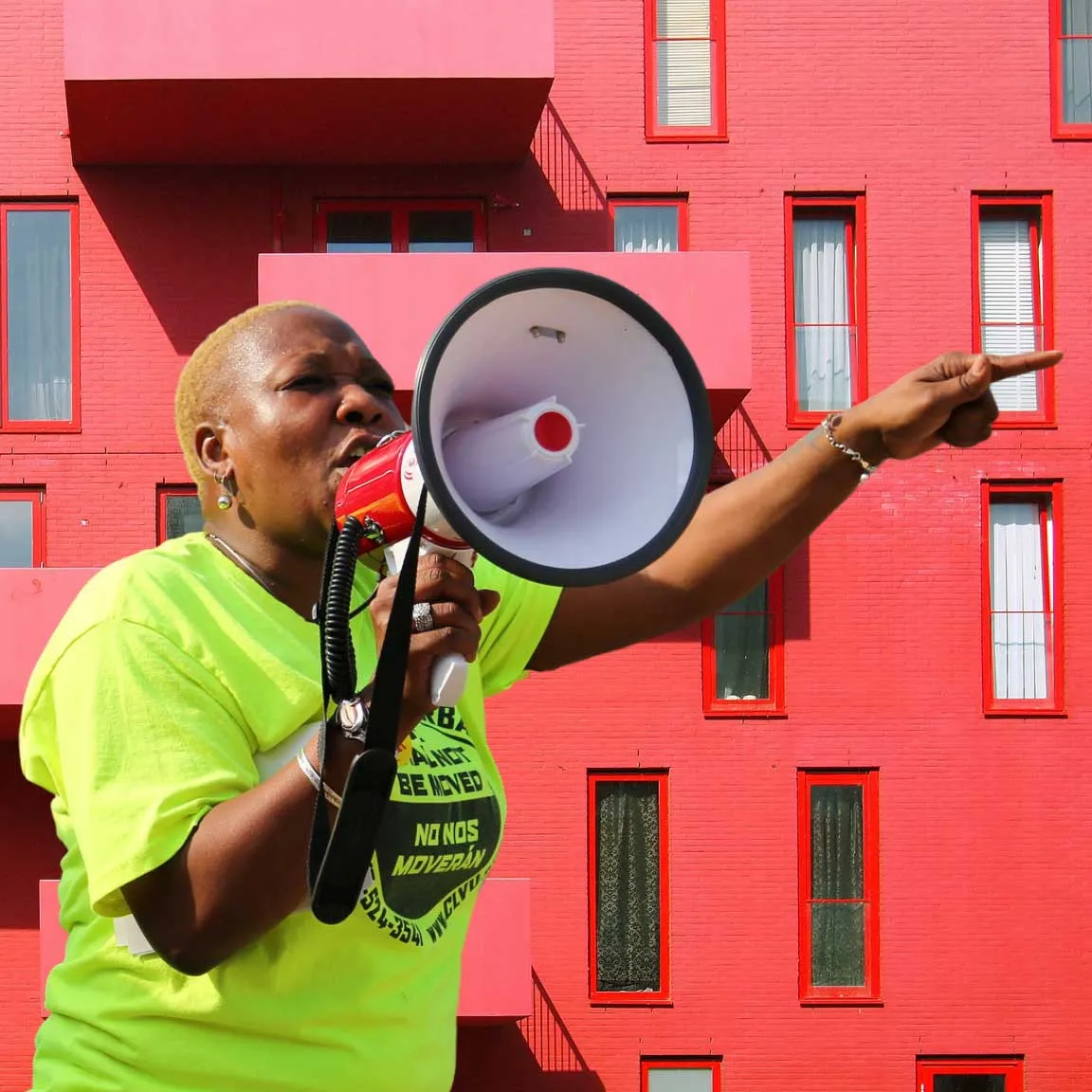
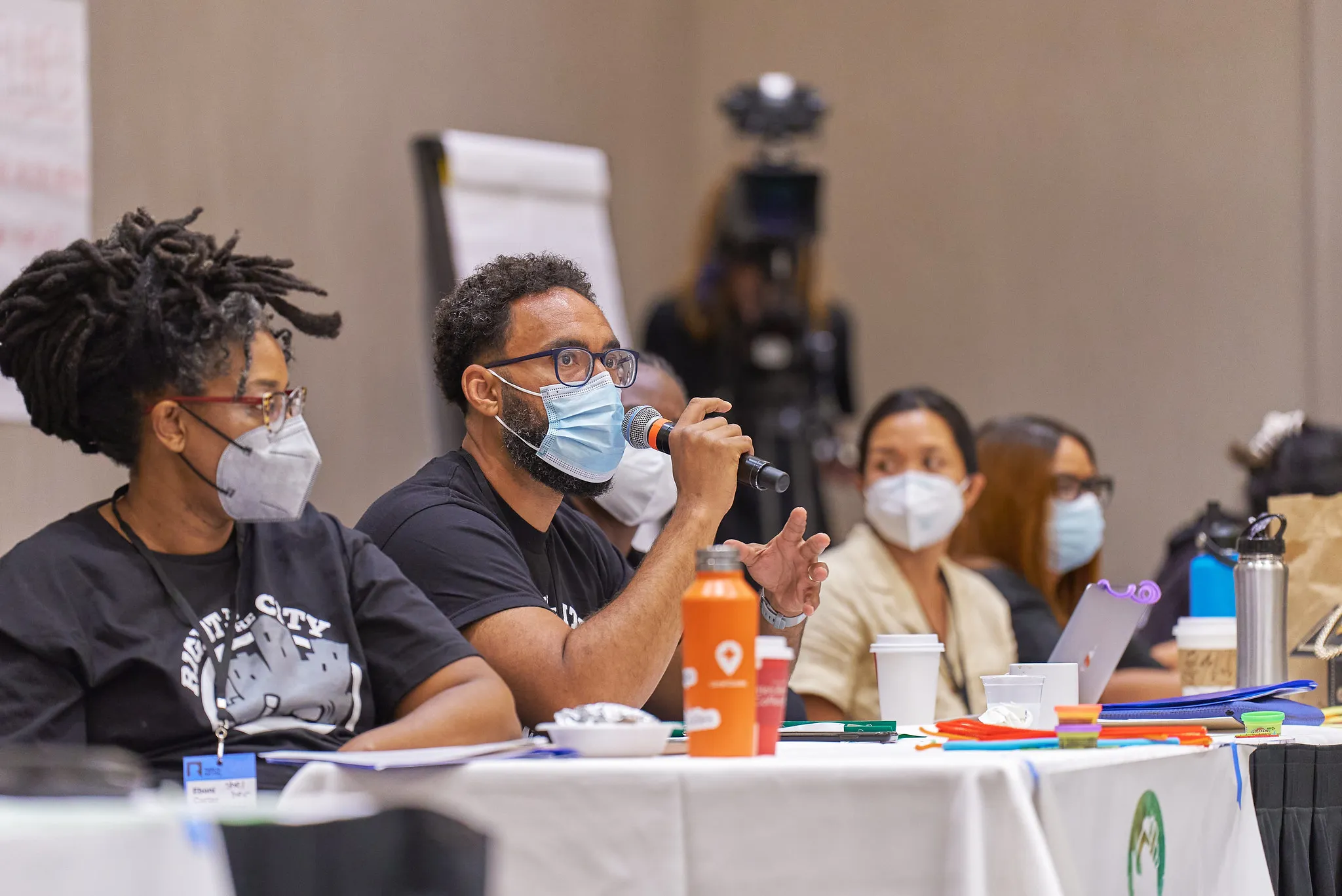
Jewel Z. Rodgers of VITAL, Lincoln Nebraska. Photo by Mike Dennis©
I grew up on the backs of black liberal literature and a neighborhood swallowed in 40 years of consecutive poverty that all of a sudden had been allowed to be “valuable” now. So, when our facilitator asks, “what does community control really look like to you?” my first thought is collective ownership and investment in our neighborhoods with our dollars.
I'd chosen this tract for a reason (development without displacement and community control).
When I was younger, I was fooled into thinking that communities get better when you make them “pretty.” When I was 17 years old, I got my first internship at an architecture firm, and quickly realized it was never about the structure, it was about the people within them. That if you do not have true community, there is no equitable development because a neighborhood without community does not have to be torn apart by gentrification simply to be divided.
When the facilitator asks us, “what development without displacement looks like,” our group member says it means stable demographic. “All people that were there before, should remain there after.” A few minutes later, we came to the conclusion that this was something that could not happen without knowing our neighbors, creating deep relationships with them, and committing to doing what we could to uplift each other.
Today, for me, was not about the technical terms, it was about discovering that beyond all of the policy changes and rent controls, direct action efforts and community land trusts, you need the love and support of your people in day-to-day community, and you yourself must also be a source of love and support, and solidarity.
This assembly was much more than training and technical terms — it was about community. It was about building together, whether you've known that person for years or not at all; the common thread can be found in many places. Although I recognize that I have much more to learn, this experience has grown me beyond any expectation and when the fight comes, I will be willing to do what it takes to win because of what I have experienced here.
By Jewel Z. Rodgers
VITAL, Lincoln, Nebraska
Jewel Z. Rodgers of VITAL, Lincoln Nebraska. Photo by Mike Dennis©
I grew up on the backs of black liberal literature and a neighborhood swallowed in 40 years of consecutive poverty that all of a sudden had been allowed to be “valuable” now. So, when our facilitator asks, “what does community control really look like to you?” my first thought is collective ownership and investment in our neighborhoods with our dollars.
I'd chosen this tract for a reason (development without displacement and community control).
When I was younger, I was fooled into thinking that communities get better when you make them “pretty.” When I was 17 years old, I got my first internship at an architecture firm, and quickly realized it was never about the structure, it was about the people within them. That if you do not have true community, there is no equitable development because a neighborhood without community does not have to be torn apart by gentrification simply to be divided.
When the facilitator asks us, “what development without displacement looks like,” our group member says it means stable demographic. “All people that were there before, should remain there after.” A few minutes later, we came to the conclusion that this was something that could not happen without knowing our neighbors, creating deep relationships with them, and committing to doing what we could to uplift each other.
Today, for me, was not about the technical terms, it was about discovering that beyond all of the policy changes and rent controls, direct action efforts and community land trusts, you need the love and support of your people in day-to-day community, and you yourself must also be a source of love and support, and solidarity.
This assembly was much more than training and technical terms — it was about community. It was about building together, whether you've known that person for years or not at all; the common thread can be found in many places. Although I recognize that I have much more to learn, this experience has grown me beyond any expectation and when the fight comes, I will be willing to do what it takes to win because of what I have experienced here.
https://www.thenation.com/article/a-new-housing-rights-movement-has-the-real-estate-industry-running-scared/
Socrates Guzman tends to get tearful when he talks about his housing troubles. For 11 years, he says, he lived in a small apartment in the Dorchester neighborhood of Boston, traveling back and forth from his job as a janitor and paying $1,000 a month in rent. Then, one day in 2016, he learned that his home had been sold to a new landlord, and that the landlord wanted to raise his rent to $1,850 a month. He would be out on the street within a month if he didn't pay up.
“There was no way I could catch up to $1,850 a month,” he says. “I can't pay that amount. That is a crazy increase.”
Guzman thought the price hike might be illegal under city law, but soon realized that rent control does not exist in Boston. So he connected with a group called City Life, a local eviction-defense group that helped him organize his neighbors. Together, they fought in housing court and stretched the legal process long enough that their new landlord eventually gave up and agreed to sign a three-year contract that significantly reduced the proposed rent hike.
Now, nearly two years later, Guzman is a full-blown tenants'-rights organizer, helping other renters navigate housing court and working with City Life on a long-term campaign to enshrine rent protections in Boston. “Rent control is the key,” he says. “Nothing else is going to help.”
Araceli Barrera is a housekeeper at a hotel in Denver. Last year, the apartment where she lives with her husband and two children was overrun with an insect infestation. She says she had to trash most of her belongings and move out. When her landlord took her to housing court to force her to fulfill the final months of her lease agreement, she turned to a local renters coalition called Colorado Homes for All. The group provided her with a pro bono lawyer who helped defend her in the case.
The experience politicized her. Now Barrera is helping Homes for All push a bill in the state legislature that would allow Colorado tenants to withhold rent from their landlords if their housing is in disrepair.
“I lost everything, my belongings, my home, and the life of my family was uprooted,” she says in Spanish. “That makes me want to fight harder. I want to go to the capitol and tell my story and be heard.
In 2013, Cynthia Berger found herself living in her minivan in Santa Cruz, California. She had lost her job after the 2008 financial crisis and had to ask friends to let her park on their property. During this period, she started studying the housing market, trying to understand why people like her were forced to live such precarious lives. She contacted a state-wide renters' organization called Tenants Together. Its staff members trained her in the art of organizing.
“I learned that renters have few rights in this state,” she says. “And I learned that rent gouging is the order of the day.”
Soon after, she started a hotline for tenants in her city. She connected with other outraged renters and housing activists. Today she and a group of allies are running a campaign to put a rent-control and just-cause-eviction ordinance on the 2018 ballot in Santa Cruz. (Just-cause-eviction regulations stipulate that landlords can evict tenants only if they fail to pay rent or somehow breach their lease. They cannot evict renters arbitrarily.)
“The landlord lobby is a billion-dollar lobby,” Berger says. “It will be hard, but we have to do it.”
These stories and others like them are the visible roots of a nascent tenants'-rights movement taking form across America today. From Massachusetts and Minnesota to California and Colorado, renters are in revolt. They are organizing in individual cities from coast to coast to form tenants' unions and push new rent regulations, including rent control, just-cause eviction and similar policies. They are working in state legislatures to overturn long-standing bans on commonsense tenant protections. And under the aegis of a national campaign called Homes for All, they are connecting with each other. Out of their disparate and localized concerns, they aim to build a mass movement that can lift housing justice to the very top of the national agenda.
“If we are going to win we have to organize a critical mass of impacted residents across the country,” says Anthony Romano, director of organizing at Right to the City, which is leading the Homes for All campaign. We have to “build an army.”
Continue Reading This Article on The Nation Website Here
By Malcolm Torrejón Chu
On October 17 and 18, 23 residents, activists and organizers from across the South gathering in Atlanta for the first Homes For All Southern Land & Housing Leadership Assembly. Members of the Housing Justice League in Atlanta, Cooperation Jackson (Mississippi), Miami Workers Center (Florida), Kentuckians For The Commonwealth and Homes For All Nashville (Tennessee) spent three days learning from each other's local organizing, getting to know and build trust with each other, developing a collective vision for expanding land & housing organizing across the south, and planning next steps to build regional power towards land & housing liberation.
We caught up with some of the participants to hear about their experience and what went down in Atlanta.
Sacajawea Hall of Cooperation Jackson opened the assembly with a collective visioning process helping to ground each of the five organizations in each other's work and begin to emerge common ideas and goals of what we want to build together. Each organization shared their vision and their short, medium and long term goals.
Kennetha Patterson of Homes For All Nashville participates and speaks at the #HFASouth Assembly.
“It was so powerful to see other states stand up as well. We all have a lot of the same ideas across the board, but also have unique and different things to offer each other. There was so much knowledge in the room.” -Kennetha Patterson, Nashville
Once grounded in each other's work, participants broke up into small groups of mixed cities to ask each other: What do we want the south to look like for our children / grandchildren?
Each group brought back a visual representation of their vision and bullet points of what they believe we must be ready to fight for together. While housing as a human right and community control of land & housing were central themes, our collective vision for the south (and the nation) was not limited to land & housing. We talked about our need to fight for a broad and intersectional vision with demands that include a living wage for all, ending mass incarceration and other economic, gender and racial justice issues.
“We get so comfortable. We get comfortable thinking that the things we take for granted, someone paid a cost for that. It was so amazing to see all of the work, the detailed work that people are doing to create change, and to take that back and get out and fight for our cause.”
-Mrs. Sheila, Cooperation Jackson
This is the first time, that we know of, that a group of southern organizers and residents have come together to plan a regional organizing strategy for land & housing in the south. The battles ahead will not be easy, but we know we won't win unless we build intersectional power across movements.
Homes For All members across the country understand that to truly secure housing as a human right for all people, our movement must confront and dismantle white supremacy and other systems of oppression and power.
From the theft of indigenous land, the enslavement and exploitation of Africans, the denial of land ownership to black and other communities of color, the creation of federal backed GSE's to support white & suburban homeownership while redlining and dis-investing from entire communities of color, to predatory lending, the destruction of public housing and gentrification of historically black and brown neighborhoods, white supremacist ideology has shaped land & housing policy for centuries.
“I was born in the south. I came from a small city of Florence MS. I got to experience some of the injustice and white supremacist way of thinking. The south is so important because this is the root of white supremacist inequality of housing, the economic struggle of people of color, and that root spreads out to different regions.” Mrs. Shelia (Jackson)
During day two of the #HFASouth Assembly, we dove deep together to understand the particular and specific ways white supremacy has shaped our communities' relationships to land & housing in the South. We emerged deeper clarity that Southern people and movements must lead and play a central role in building a regional, national and international movement for land & housing liberation that centers the fight to dismantle white supremacy, win reparations and transform our communities.
We're looking forward to building together and creating change as we stand as a unified group. It's exciting to think about tackling this issue in the south in particular. Through Homes for All South, we will be directly confronting racial, economic, and housing injustice at its source. Meeting with our Homes for All partners in Atlanta gave us hope that we can create the vision we are looking towards as we build and grow together. (Meredith Wadlington, Kentucky)
“Atlanta was just the beginning. Our hope in birthing #HFASouth is that this is just the planting of the seeds. Next is to grow our roots – meaning we must deepen our collective unity around vision & goals and reach out to bring in more cities and organizations to this critical regional organizing.” -Tony Romano, Atlanta

Members vote to officially form #HFASouth at the October Assembly, pending consultation and discussion with each of the five member organizations.
On day two of the convening, we unanimously decided to form Homes For All South (#HFASouth) and to move forward with plans to hold a bigger Southern HFA Assembly in Spring 2018 in either Jackson, MS or Nashville, TN. We plan to bring together as many as a hundred residents, organizers and freedom fighters actively engaged in land & housing struggles along with allies from other movements to train & educate each other on cutting edge organizing strategies, develop shared strategy and grow our movement.
I left Atlanta thinking “What Can I Do”? How can I work with my community to transform the way that things are done? I've been talking about it with friends since I've been back. Anytime you can put something together that causes us to talk. To have people with from different experiences in life in a space to really be able to talk, to listen, without judgement, and talk from the heart, that's a really really great experience.” -Mrs. Sheila (Jackson)
Over the next years we plan to recruit and support the development of new housing and land justice organizations including tenant unions, neighborhood organizations and Community Land Trusts, as well as to build deep partnerships across other sectors and movements. HFA South covers the following states: Mississippi, Louisiana, Georgia, Alabama, Florida, South Carolina, North Carolina, Tennessee, Arkansas, Kentucky. Parts of Texas, Virginia and West Virginia are being considered.

A larger regional assembly is planned for next May in either Jackson, MS or Nashville, TN. Credit: Mike Dennis
By building a unified land & housing movement across the south we can contribute to a broader movement to confront the rise of the neo-confederacy and win land, liberation and freedom for our people.
While the collective time together was transformative and powerful, for many participants getting a chance to learn from the local movement for development without displacement and to fight back against gentrification in Atlanta was a highlight.
My highlight was going to the Housing Justice League monthly meeting and learning about their Beltline Report. We then got to break out into a tenant association meeting. I learned so much, it was so real and raw. I was in there with Ms Sherise from Atlanta, being able to see how other folks engage tenants and organize tenants. The tenants coming in were elderly and were being bullied and left the room with hope. As an organizer who is going to be leading tenant union meetings in the future in Nashville, it was very informative and I got to learn a lot about how to organize. -Kennetha Patterson

Sherise Brown of the Housing Justice League in Atlanta participates in the #HFASouth Assembly. Credit: Mike Dennis
The Housing Justice League recently released a powerful new report on the Beltline Development project laying out an alternative vision for development that guarantees and protects the right of long-term black, low-income and working-class communities to remain in their homes. They are organizing tenants unions, neighborhood assemblies and holding monthly organizing meetings to build power.
On Day Three of the gathering, we were joined by our sister and brothers from It Takes Roots and other movement organizations for a day-long Direct Action Strategy training put on by the Ruckus Society and Blackout Collective. Homes For All members built across social movements with comrades from Southerners On New Ground (SONG), SNAPCO, Black Alliance for Just Immigration, Southern Appalachian Mountain Stewards and the North Carolina Climate Justice Summit.

Participants role play eviction blockades at Non-Violent Direct Action Training led by the Ruckus Society.
We learned about direct action strategy, how to plan a direct action, common roles in actions, discussed how to challenge those in power and practiced eviction blockades and civil disobedience to build our skills and get ready to fight for our people and communities.
“One of the discussions that opened the training was around non-violence and offensive versus defensive actions. It was helpful to move through the steps of planning an action, and the materials that Ruckus shared will be helpful templates that we will put to good use as our state moves into the General Assembly” – Laura Harper (Kentuckians For The Commonwealth)
The Direct Action training was put on as part of Right To The City's collaboration with It Takes Roots which includes Grassroots Global Justice Alliance, Climate Justice Alliance, the Indigenous Environmental Network, Center for Story Based Strategy and the Ruckus Society. Over the next 9 months we are convening regional and national cross-movement direct action strategy trainings to deepen the skills and capacities of communities on the frontlines of grassroots movements for transformative change to take bold and escalated action together and lead visionary alternatives to the right wing agenda.
Photo Credits: Mike Dennis
For more information about Homes For All's southern regional organizing please contact Tony Romano at Tony [at] RightToTheCity [dot] org.
By Malcolm Torrejón Chu
On October 17 and 18, 23 residents, activists and organizers from across the South gathering in Atlanta for the first Homes For All Southern Land & Housing Leadership Assembly. Members of the Housing Justice League in Atlanta, Cooperation Jackson (Mississippi), Miami Workers Center (Florida), Kentuckians For The Commonwealth and Homes For All Nashville (Tennessee) spent three days learning from each other's local organizing, getting to know and build trust with each other, developing a collective vision for expanding land & housing organizing across the south, and planning next steps to build regional power towards land & housing liberation.
We caught up with some of the participants to hear about their experience and what went down in Atlanta.
Sacajawea Hall of Cooperation Jackson opened the assembly with a collective visioning process helping to ground each of the five organizations in each other's work and begin to emerge common ideas and goals of what we want to build together. Each organization shared their vision and their short, medium and long term goals.
Kennetha Patterson of Homes For All Nashville participates and speaks at the #HFASouth Assembly.
“It was so powerful to see other states stand up as well. We all have a lot of the same ideas across the board, but also have unique and different things to offer each other. There was so much knowledge in the room.” -Kennetha Patterson, Nashville
Once grounded in each other's work, participants broke up into small groups of mixed cities to ask each other: What do we want the south to look like for our children / grandchildren?
Each group brought back a visual representation of their vision and bullet points of what they believe we must be ready to fight for together. While housing as a human right and community control of land & housing were central themes, our collective vision for the south (and the nation) was not limited to land & housing. We talked about our need to fight for a broad and intersectional vision with demands that include a living wage for all, ending mass incarceration and other economic, gender and racial justice issues.
“We get so comfortable. We get comfortable thinking that the things we take for granted, someone paid a cost for that. It was so amazing to see all of the work, the detailed work that people are doing to create change, and to take that back and get out and fight for our cause.”
-Mrs. Sheila, Cooperation Jackson
This is the first time, that we know of, that a group of southern organizers and residents have come together to plan a regional organizing strategy for land & housing in the south. The battles ahead will not be easy, but we know we won't win unless we build intersectional power across movements.
Homes For All members across the country understand that to truly secure housing as a human right for all people, our movement must confront and dismantle white supremacy and other systems of oppression and power.
From the theft of indigenous land, the enslavement and exploitation of Africans, the denial of land ownership to black and other communities of color, the creation of federal backed GSE's to support white & suburban homeownership while redlining and dis-investing from entire communities of color, to predatory lending, the destruction of public housing and gentrification of historically black and brown neighborhoods, white supremacist ideology has shaped land & housing policy for centuries.
“I was born in the south. I came from a small city of Florence MS. I got to experience some of the injustice and white supremacist way of thinking. The south is so important because this is the root of white supremacist inequality of housing, the economic struggle of people of color, and that root spreads out to different regions.” Mrs. Shelia (Jackson)
During day two of the #HFASouth Assembly, we dove deep together to understand the particular and specific ways white supremacy has shaped our communities' relationships to land & housing in the South. We emerged deeper clarity that Southern people and movements must lead and play a central role in building a regional, national and international movement for land & housing liberation that centers the fight to dismantle white supremacy, win reparations and transform our communities.
We're looking forward to building together and creating change as we stand as a unified group. It's exciting to think about tackling this issue in the south in particular. Through Homes for All South, we will be directly confronting racial, economic, and housing injustice at its source. Meeting with our Homes for All partners in Atlanta gave us hope that we can create the vision we are looking towards as we build and grow together. (Meredith Wadlington, Kentucky)
“Atlanta was just the beginning. Our hope in birthing #HFASouth is that this is just the planting of the seeds. Next is to grow our roots – meaning we must deepen our collective unity around vision & goals and reach out to bring in more cities and organizations to this critical regional organizing.” -Tony Romano, Atlanta

Members vote to officially form #HFASouth at the October Assembly, pending consultation and discussion with each of the five member organizations.
On day two of the convening, we unanimously decided to form Homes For All South (#HFASouth) and to move forward with plans to hold a bigger Southern HFA Assembly in Spring 2018 in either Jackson, MS or Nashville, TN. We plan to bring together as many as a hundred residents, organizers and freedom fighters actively engaged in land & housing struggles along with allies from other movements to train & educate each other on cutting edge organizing strategies, develop shared strategy and grow our movement.
I left Atlanta thinking “What Can I Do”? How can I work with my community to transform the way that things are done? I've been talking about it with friends since I've been back. Anytime you can put something together that causes us to talk. To have people with from different experiences in life in a space to really be able to talk, to listen, without judgement, and talk from the heart, that's a really really great experience.” -Mrs. Sheila (Jackson)
Over the next years we plan to recruit and support the development of new housing and land justice organizations including tenant unions, neighborhood organizations and Community Land Trusts, as well as to build deep partnerships across other sectors and movements. HFA South covers the following states: Mississippi, Louisiana, Georgia, Alabama, Florida, South Carolina, North Carolina, Tennessee, Arkansas, Kentucky. Parts of Texas, Virginia and West Virginia are being considered.

A larger regional assembly is planned for next May in either Jackson, MS or Nashville, TN. Credit: Mike Dennis
By building a unified land & housing movement across the south we can contribute to a broader movement to confront the rise of the neo-confederacy and win land, liberation and freedom for our people.
While the collective time together was transformative and powerful, for many participants getting a chance to learn from the local movement for development without displacement and to fight back against gentrification in Atlanta was a highlight.
My highlight was going to the Housing Justice League monthly meeting and learning about their Beltline Report. We then got to break out into a tenant association meeting. I learned so much, it was so real and raw. I was in there with Ms Sherise from Atlanta, being able to see how other folks engage tenants and organize tenants. The tenants coming in were elderly and were being bullied and left the room with hope. As an organizer who is going to be leading tenant union meetings in the future in Nashville, it was very informative and I got to learn a lot about how to organize. -Kennetha Patterson

Sherise Brown of the Housing Justice League in Atlanta participates in the #HFASouth Assembly. Credit: Mike Dennis
The Housing Justice League recently released a powerful new report on the Beltline Development project laying out an alternative vision for development that guarantees and protects the right of long-term black, low-income and working-class communities to remain in their homes. They are organizing tenants unions, neighborhood assemblies and holding monthly organizing meetings to build power.
On Day Three of the gathering, we were joined by our sister and brothers from It Takes Roots and other movement organizations for a day-long Direct Action Strategy training put on by the Ruckus Society and Blackout Collective. Homes For All members built across social movements with comrades from Southerners On New Ground (SONG), SNAPCO, Black Alliance for Just Immigration, Southern Appalachian Mountain Stewards and the North Carolina Climate Justice Summit.

Participants role play eviction blockades at Non-Violent Direct Action Training led by the Ruckus Society.
We learned about direct action strategy, how to plan a direct action, common roles in actions, discussed how to challenge those in power and practiced eviction blockades and civil disobedience to build our skills and get ready to fight for our people and communities.
“One of the discussions that opened the training was around non-violence and offensive versus defensive actions. It was helpful to move through the steps of planning an action, and the materials that Ruckus shared will be helpful templates that we will put to good use as our state moves into the General Assembly” – Laura Harper (Kentuckians For The Commonwealth)
The Direct Action training was put on as part of Right To The City's collaboration with It Takes Roots which includes Grassroots Global Justice Alliance, Climate Justice Alliance, the Indigenous Environmental Network, Center for Story Based Strategy and the Ruckus Society. Over the next 9 months we are convening regional and national cross-movement direct action strategy trainings to deepen the skills and capacities of communities on the frontlines of grassroots movements for transformative change to take bold and escalated action together and lead visionary alternatives to the right wing agenda.
Photo Credits: Mike Dennis
For more information about Homes For All's southern regional organizing please contact Tony Romano at Tony [at] RightToTheCity [dot] org.
By The All-Nite Images from NY, NY, USA (A Day In New York 14th May 2015: Rally to Save NYC) [CC BY-SA 2.0], via Wikimedia Commons
October 2, 2017; Marketplace
PRI's Marketplace featured a report on one way that New York City is seeking to empower tenants. The article, “New York is betting $155 million that it can cut evictions,” describes the city's effort to provide legal representation to low-income tenants facing eviction. The payoff to the city is reduced social service costs for shelter and relocation. According to Steven Banks, commissioner of the city's Department of Social Services:
More than 59,000 people sleep in New York City's homeless shelters every night. The new law could help people stay in their homes instead.… And there's an economic argument for that.… To spend a couple of thousand dollars to provide legal services versus tens of thousands of dollars to provide shelter makes this a very good investment.
Support for legal representation has been championed by advocacy nonprofits in recognition of the fact that more than 90 percent of tenants go to eviction court without a lawyer.
Subsidizing legal representation in housing court is only one of a series of strategies being used to protect low-income renters. In past months, NPQ has covered other efforts, most inspired by activists in New York City, to create eviction court navigators, outlaw landlord harassment of tenants, and curtail blacklisting of tenants. Lack of affordable housing in New York City is part of a larger nest of problems faced by low-wage households. Landlords are using aggressive techniques to force tenants out of rent-controlled units so they can get higher rents from more affluent home-seekers. Predatory rental practices may have increased as demand for rental housing has risen across the country. Yet another factor shaping rental practices has been the corporatization of rental property ownership.
New York's mayor, William “Bill” de Blasio, has made expanding the number of affordable housing units a key strategy for his administration, but at the end of four years, the mayor seems unable to build his way out of the affordability problem. Eviction representation is another tactic to preserve existing affordable units.
Besides the savings to the municipal budget, there are less tangible benefits to be derived from stable rental housing. One is economic. Most cities depend on a workforce of lower wage workers who need stable rental housing to be productive employees. The nonprofit research and advocacy organization PolicyLink has a new study that details the economic impact on cities of stable rental housing and tenant-friendly public policies. A study from Cleveland State University's College of Urban Affairs suggests that the most economically distressed city in the United States can “grow from the inside” based on the new renters.
Another benefit is political. Tenants are gaining electoral power in places like New York City. There's an emerging social movement in US cities that's sometimes characterized as the Renter Nation. This movement brings together young urban renters, childless boomers choosing an urban lifestyle, and former homeowners who have been displaced into single-family rentals by the Great Recession. These “new renters” are adding fuel (and political power) to the struggle of low-income households in inner-city subsidized developments. While nonprofits like Right to the City and PolicyLink are giving voice to this emerging movement, other more traditional housing advocacy and fair housing organizations are also feeling the energy. WBUR's On Point features a segment on this profound demographic shift. Throughout the half-hour discussion, the panelists reiterate that the emergence of a renter nation is “market driven,” not an investor conspiracy.
In the early aftermath of the Great Recession, there was a sense among the FIRE (Finance, Insurance, and Real Estate) industries that homeownership would bounce back as the wreckage of foreclosed homes were sold off, as displaced owners' credit records were cleared, and as the millennial generation reached the age for first time home buying. That hopeful scenario of 2010 now seems naïve in the face of our present reality.—Spencer Wells
By The All-Nite Images from NY, NY, USA (A Day In New York 14th May 2015: Rally to Save NYC) [CC BY-SA 2.0], via Wikimedia Commons
October 2, 2017; Marketplace
PRI's Marketplace featured a report on one way that New York City is seeking to empower tenants. The article, “New York is betting $155 million that it can cut evictions,” describes the city's effort to provide legal representation to low-income tenants facing eviction. The payoff to the city is reduced social service costs for shelter and relocation. According to Steven Banks, commissioner of the city's Department of Social Services:
More than 59,000 people sleep in New York City's homeless shelters every night. The new law could help people stay in their homes instead.… And there's an economic argument for that.… To spend a couple of thousand dollars to provide legal services versus tens of thousands of dollars to provide shelter makes this a very good investment.
Support for legal representation has been championed by advocacy nonprofits in recognition of the fact that more than 90 percent of tenants go to eviction court without a lawyer.
Subsidizing legal representation in housing court is only one of a series of strategies being used to protect low-income renters. In past months, NPQ has covered other efforts, most inspired by activists in New York City, to create eviction court navigators, outlaw landlord harassment of tenants, and curtail blacklisting of tenants. Lack of affordable housing in New York City is part of a larger nest of problems faced by low-wage households. Landlords are using aggressive techniques to force tenants out of rent-controlled units so they can get higher rents from more affluent home-seekers. Predatory rental practices may have increased as demand for rental housing has risen across the country. Yet another factor shaping rental practices has been the corporatization of rental property ownership.
New York's mayor, William “Bill” de Blasio, has made expanding the number of affordable housing units a key strategy for his administration, but at the end of four years, the mayor seems unable to build his way out of the affordability problem. Eviction representation is another tactic to preserve existing affordable units.
Besides the savings to the municipal budget, there are less tangible benefits to be derived from stable rental housing. One is economic. Most cities depend on a workforce of lower wage workers who need stable rental housing to be productive employees. The nonprofit research and advocacy organization PolicyLink has a new study that details the economic impact on cities of stable rental housing and tenant-friendly public policies. A study from Cleveland State University's College of Urban Affairs suggests that the most economically distressed city in the United States can “grow from the inside” based on the new renters.
Another benefit is political. Tenants are gaining electoral power in places like New York City. There's an emerging social movement in US cities that's sometimes characterized as the Renter Nation. This movement brings together young urban renters, childless boomers choosing an urban lifestyle, and former homeowners who have been displaced into single-family rentals by the Great Recession. These “new renters” are adding fuel (and political power) to the struggle of low-income households in inner-city subsidized developments. While nonprofits like Right to the City and PolicyLink are giving voice to this emerging movement, other more traditional housing advocacy and fair housing organizations are also feeling the energy. WBUR's On Point features a segment on this profound demographic shift. Throughout the half-hour discussion, the panelists reiterate that the emergence of a renter nation is “market driven,” not an investor conspiracy.
In the early aftermath of the Great Recession, there was a sense among the FIRE (Finance, Insurance, and Real Estate) industries that homeownership would bounce back as the wreckage of foreclosed homes were sold off, as displaced owners' credit records were cleared, and as the millennial generation reached the age for first time home buying. That hopeful scenario of 2010 now seems naïve in the face of our present reality.—Spencer Wells
The Right to the City Alliance is building a strong housing and urban justice movement in America and beyond. The idea of a right to the city frames and activates a new kind of urban politic that asserts that everyone, particularly the disenfranchised, not only have a right to the city, but as inhabitants, have a right to shape it, design it, and operationalize an urban human rights agenda. Learn More »
No homes without people, no people without homes!
Right To The City relies on the support of individuals like yourself. By making a donation you are helping us provide a national movement building infrastructure for grassroots organizations addressing gentrification and urban displacement, coordinate national campaigns and capacity building programs, and organize national convenings and mobilizations. Please give today, and consider giving a contribution that is meaningful to you. No gift is too small, and all gifts are appreciated. Click here to make a one time donation or sign up as a monthly sustainer.